jDAS in a nutshell
jDAS is a self-supervised Deep Learning model for denoising of Distributed Acoustic Sensing (DAS) data. The principle that underlies jDAS is that spatio-temporally coherent signals can be interpolated, while incoherent noise cannot. Leveraging the framework laid out by Batson & Royer (2019; ICML), jDAS predicts the recordings made at a target channel using the target’s surrounding channels. As such, it is a self-supervised method that does not require “clean” (noise-free) waveforms as labels.
Retraining the model on new data is quick and easy, and will produce an optimal separation between coherent signals and incoherent noise for your specific dataset:
from jDAS import JDAS
jdas = JDAS()
data_loader = jdas.init_dataloader(data)
model = jdas.load_model()
model.fit(data_loader, epochs=50)
Denoising your data is then done through a single function call:
clean_data = jdas.denoise(data)
That’s all!
Example
The example below is taken from a submarine DAS experiment conducted offshore Greece. At around 25 seconds and earthquake hits the DAS cable and induces a spatio-temporally coherent strain field. jDAS removes the incoherent background noise while keeping the earthquake signals.
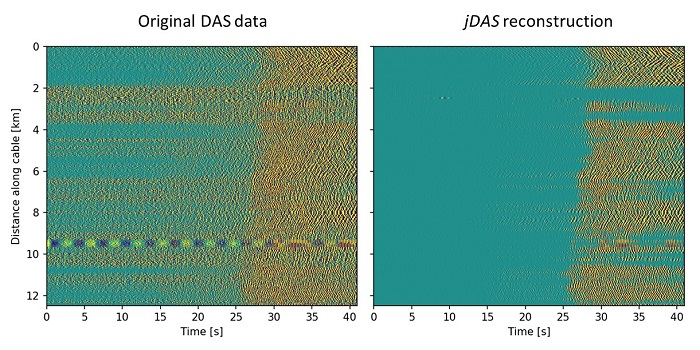
Note that some aliasing artifacts have been introduced in rendering this static JPEG. A code example to reproduce this figure is included in the examples directory of the project.